

Processing Rare Earth Elements for Battery & EV Applications: How particle size, morphology, and purity affect cathode/anode performance in next‑gen batteries.
June 17, 2026
Rare Earth processing plays an important role in battery and EV applications; these decisions can affect how these materials perform in next-generation cathode and anode systems. That is why the goal is not only to produce powder, but to produce material with the characteristics needed for advanced battery performance.
Rare Earth processing supports battery performance in more than one way
Not every EV battery chemistry depends on rare earths in the same way. In lithium-ion systems, rare-earth elements are often used as modifiers, dopants, or coatings for advanced cathode materials, meaning that they are not the main active ingredient in every cell. Research on Ni-rich cathodes, for example, describes rare-earth elements as potential modifiers that can address chemical, structural, and thermal instability through doping and coating. Recent review work also shows growing interest in rare-earth-based materials for next-generation solid-state batteries.
That distinction matters because it changes the processing conversation. When a material is used to tune electrochemical behavior, structural stability, or interfacial performance, powder characteristics become part of the design. In those cases, Rare Earth processing is not only about supply, it is also about delivering a powder that fits its intended electrochemical role.
Particle size influences reaction behavior and consistency
Particle size is one of the clearest links between powder processing and battery performance. In battery material production, ultra-fine milling, controlled size reduction, and narrow particle-size distribution all play an important role. They affect particle shape, flowability, surface area, and electrochemical behavior. Advanced ultra-fine milling solutions and related mills and classifiers are often used to support that level of control.
That principle matters for rare-earth-containing battery powders as well— if particle size drifts too wide, performance can become less predictable across the process. Oversized particles may affect uniformity, while excess ultrafines can create handling, purity, or recovery challenges. In battery materials, tighter size control often helps support more consistent product behavior from processing through final use.

Morphology shapes packing, flow, and electrochemical behavior
Morphology refers to the shape, surface structure, and overall form of a particle. In battery materials, those traits matter because powders need to flow, mix, coat, densify, and cycle reliably inside the cell, rather than just exist as raw particles.
In cathode active materials, precursor composition, crystallinity, and particle morphology all influence electrochemical behavior and durability. They can affect cation distribution, defect levels, and lithium-ion mobility, depending on how the precursor is formed and processed, making particle design and modification critical in advanced powder processing.
Anode processing shows the same principle from another angle. Graphite rounding, for example, can improve tap density, storage capacity, fast-charging capability, service life, and lithium-ion intercalation kinetics. That is a useful reminder that particle shape also affects how active material packs and performs inside the cell. In Rare Earth battery-related applications, morphology can similarly influence how uniformly a material integrates into cathode or next-generation electrode systems.
Purity becomes more important as materials become more specialized
Purity is one of the most important requirements in advanced battery materials because of the fact that even the slightest amount of contamination cause create problems within a battery precursor. High-purity inputs help support the right morphology, phase formation, and long-term performance. Even minor impurities can introduce defects, secondary phases, reduced ionic conductivity, lower capacity, and faster capacity fade.
Purity control matters so much in Rare Earth processing because contamination can undercut the performance gains they are meant to deliver when rare-earth materials modify high-value cathodes or other next-generation battery components. Containment and isolation systems and broader high-purity powder processing support become especially important as cleanability, wear protection, and low-contamination processing all help protect the value of the material.
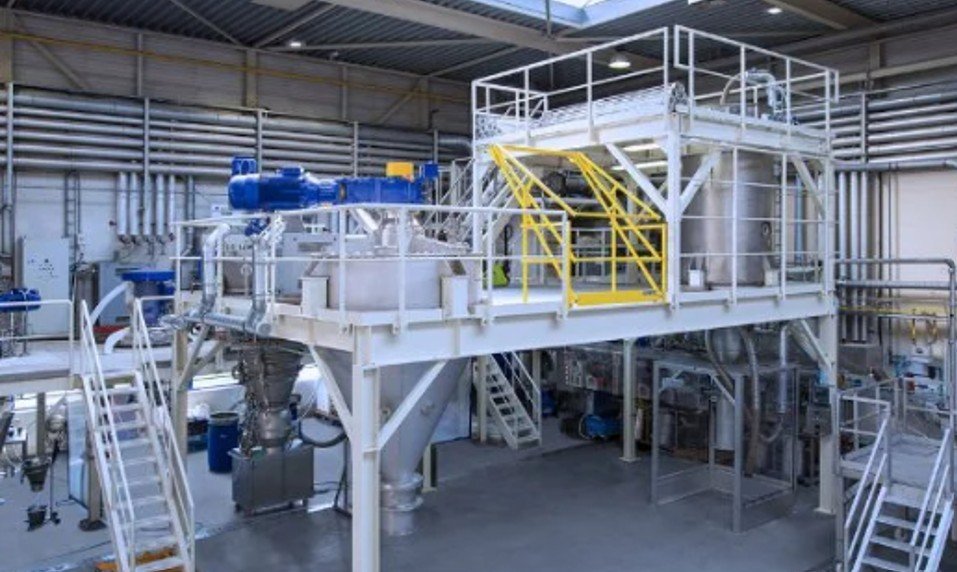
Processing has to connect size, shape, and purity as one system
Battery performance rarely depends on one powder attribute alone as particle size, morphology, and purity work together. A powder may be fine enough but still performed poorly if its shape limits packing efficiency. It may have the right morphology but still fall short if contamination affects phase purity or interface stability. That is why integrated processing matters.
In battery material production, several process steps help shape performance together, including:
-
drying
-
ultra-fine milling
-
particle shaping or spheroidisation
-
high-shear mixing
-
pilot testing and process development
Broader powder and particle processing systems are designed around that kind of connected approach, while process development and laboratory testing help validate performance before full-scale production.
That broader view is useful for Rare Earth battery applications. Whether the material supports cathode modification, advanced anode formulation, or next-generation battery systems, the process has to do more than reduce size. It also has to preserve purity, control morphology, and support repeatable powder behavior from development through scale-up.
Rare Earth battery materials demand precise powder processing
The role of Rare Earth materials in batteries and EV applications may vary by chemistry, but the processing priorities stay consistent. Particle size affects electrochemical behavior and consistency. Morphology affects packing, flow, and interface performance. Purity affects phase quality, defects, and long-term reliability. When those three factors are controlled together, the material has a better chance of delivering the performance the cell design expects.
For teams evaluating powder-processing strategies for battery materials, explore battery material processing solutions for support with advanced powders, high-purity materials, and scalable process development. Contact us to know more.